
A SMALL DAEMON. A CONTINUOUS LOOP.
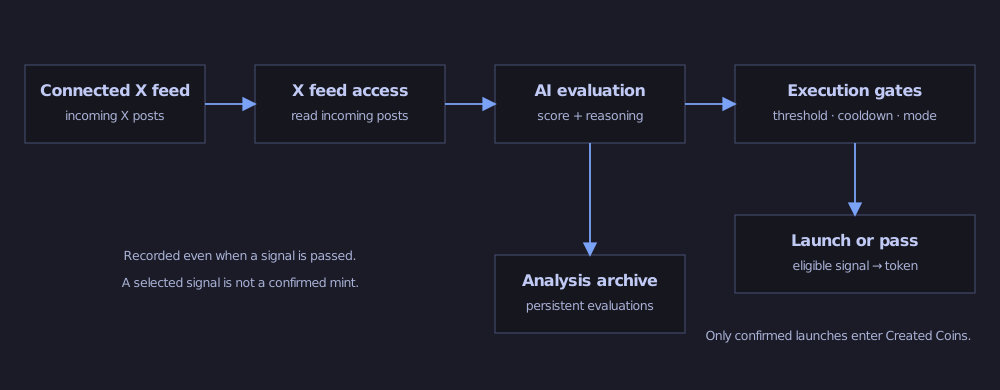
A Unix daemon reads input, processes it and writes output. OmarchyNetwork follows the same contract: a post enters through the X feed, the AI evaluates its narrative, and the launch system acts when its configured conditions are met.
The desktop makes that process visible: the terminal shows each post and its verdict, the state window shows the latest score against the threshold, and Feed Synapses records every evaluation. The score, threshold and execution mode come from the application.
ONE EVALUATED TWEET. ONE NEW NEURON.
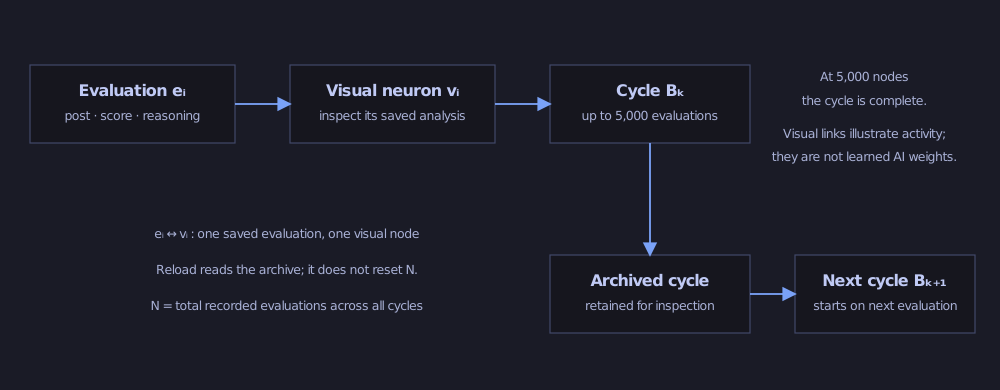
Every recorded X post evaluation adds one visual neuron to the current network. On arrival it connects to neurons that already exist in the neighbouring layers: 2 links at the lowest score, up to 6 at the highest, so the network gets denser with every tweet. Its score and analysis stay attached to that neuron, ready to inspect in Feed Synapses. The brain grows as the daemon reads and evaluates its connected feed.
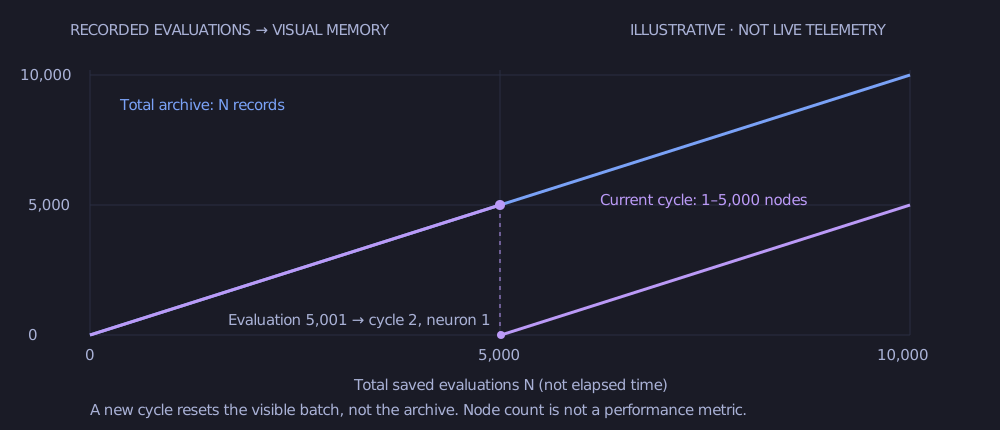
At 5,000 recorded evaluations, the cycle is complete and a new visual neural network begins. Completed brains remain in the archive. Counts and analyses are stored continuously across visits and deployments; refreshing the page does not restart the cycle.
These neurons visualize saved evaluations and their connections. Starting a new visual brain does not create or retrain a new AI model. The self-learning ambition is to use each round's measured results to improve the next round's decisions.
EVERY CYCLE ENDS WITH A LESSON.
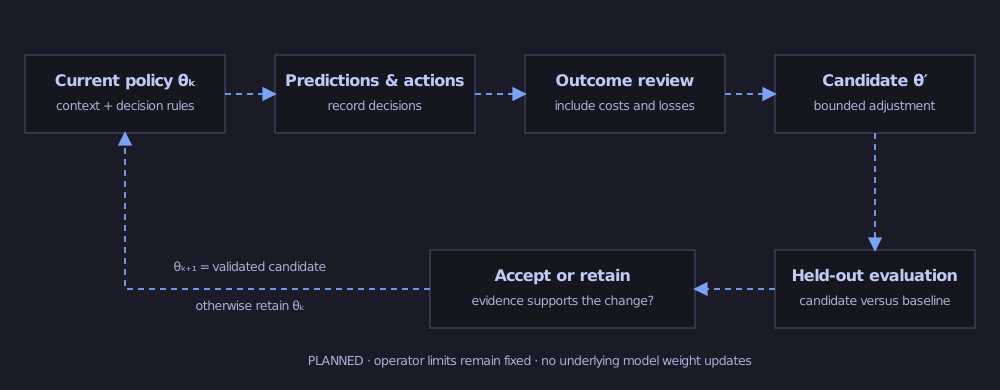
The planned self-learning loop will evaluate every completed cycle and use its results to adapt the next one. The daemon will compare its original signal score with the observed outcome, review what worked and what failed, and carry those lessons into its next evaluation.
Today, the app scores incoming posts and tracks launch outcomes. Automated feedback into future scoring is the next step: adapting decision context and configured rules, with changes kept within operator limits. This describes application-level learning, rather than automatic retraining of the underlying OpenAI model.
Why recursive? The proposed loop would review the decision process itself: compare predictions with outcomes, propose a bounded change, test it against a baseline, then carry forward only changes supported by evidence. The next round would evaluate both new signals and the effects of earlier adjustments.
A completed 5,000-evaluation cycle is a review checkpoint, not proof of improvement. Testing should include unseen observations, fees, losses and changing market conditions. If a change fails to improve measured performance, the system should retain or restore the earlier rules. This review-and-adapt mechanism is planned; the current visual network records evaluations.
DO ONE THING. PIPE THE REST.
Each stage is small and inspectable: ingest, score, gate, execute, archive. Like a pipeline of command-line tools, every stage writes something you can read back: the feed log, the score and its reasoning, the neuron record and the launch record.
Feed Synapses is a visual record of that pipeline, not a trained network or a model making trading decisions on its own.
A COIN LAUNCHES WHEN THE NETWORK FIRES.
Coins are launched on the flow through the neural network, not on a single score. Every post gets a synaptic activation from 1 to 100 %. It is not rounded to tens: it is measured from three inputs.
The network fires only when all three agree: the activation crosses the threshold, the post matches something moving on pump.fun right now, and it overlaps with enough earlier posts in the synapses. Only then is a coin created. Cooldowns, dry-run mode and position management still apply. Every post shows its activation, synapse count and pump.fun matches in the feed.
The operator can tune the threshold, the number of overlaps and the market requirement, or switch back to the legacy AI-score rule.
In dry-run mode execution is simulated.
MEMORY, FEEDBACK AND EVIDENCE.
The drawings describe this application's architecture. The studies below provide related ideas; they do not validate OmarchyNetwork's trading performance or establish that its visual network is a trained model.
01 · Inference is a decision step
A post arrives from the connected X feed. The scorer returns a narrative score and reasoning; the network adds pump.fun resonance and synaptic overlaps to form the activation. The activation is not a calibrated probability of profit. The firing rule and execution conditions determine whether a launch is attempted; blockchain confirmation determines whether it completed.
02 · A neuron is an inspectable record
The stored record contains an ID, time, source, score, reasoning, cycle and position. Feed Synapses maps records to visual nodes. Animated links communicate activity; they do not represent a learned weight matrix, gradient descent or biological synapses.
03 · Feedback can change context
Reflexion stores textual reflections in episodic memory to inform later attempts without updating model weights. This motivates our planned application-level memory loop. The current evaluation archive does not yet perform that reflective update. [1] Shinn et al., Reflexion (2023) ↗
04 · Revision needs evaluation
Self-Refine alternates generation, feedback and revision using an LLM, without additional training. Its results concern the tasks evaluated in that paper. Our proposed outcome-review loop is an adaptation of this general idea, not a reproduction of its experiments. [2] Madaan et al., Self-Refine (2023) ↗
HOW WOULD WE TEST A BETTER ROUND?
Proposed evaluation protocol. Use earlier observations to propose a change, a separate later period to select it, and a final untouched period to test it. Fix the outcome definition and observation horizon before reviewing results. Keep the original policy as a baseline and give both versions the same execution constraints.
Report sample sizes, rejected signals, failed launches, fees, slippage and losses alongside any returns. Evaluate selection quality and operational reliability separately. Retain the baseline if evidence is inconclusive. The 5,000-record batch is a product checkpoint, not a statistically established sample requirement.
No measured improvement curve is shown here: an upward line would imply evidence that has not yet been collected. A future results panel should show actual baseline comparisons and uncertainty, including rounds that get worse.
Figures 01–04 are original explanatory diagrams for OmarchyNetwork. References describe related research; planned mechanisms are explicitly marked. No study cited here demonstrates profitability for this project.